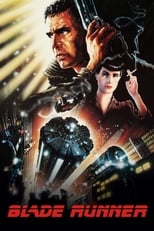
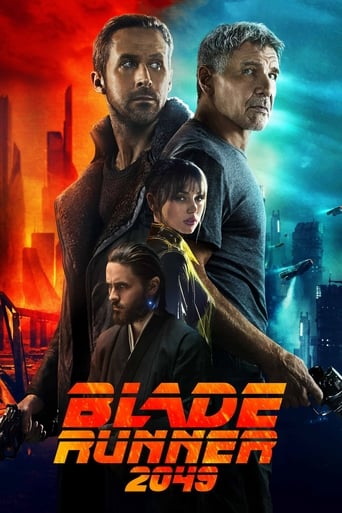
Thirty years after the events of the first film, a new blade runner, LAPD Officer K, unearths a long-buried secret that has the potential to plunge what's left of society into chaos. K's discovery leads him on a quest to find Rick Deckard, a former LAPD blade runner who has been missing for 30 years.
Per-scene lighting plots: fixture role (key / fill / back / practical), color temperature, diffusion stack, and motivation notes from cited supervisor interviews.
Sapper Morton's protein farm: a single hot overhead-bar fixture motivated by the rural farm's industrial lighting. No fill on the cast side; Deakins lets the LogC3 latitude carry the underexposed shadow side, with the protein-vat practicals (mini soft boxes inside the vat covers) providing a low-temperature kiss.
Setup defined; no fixtures plotted yet.
Iceland Westfjords exterior + Origo Stage 4 interior cover. The vat-cover practicals were custom-built by gaffer Andy Lowe to look like industrial fluorescents; the mealworm protein "soup" was prop-shop salt water with green dye.
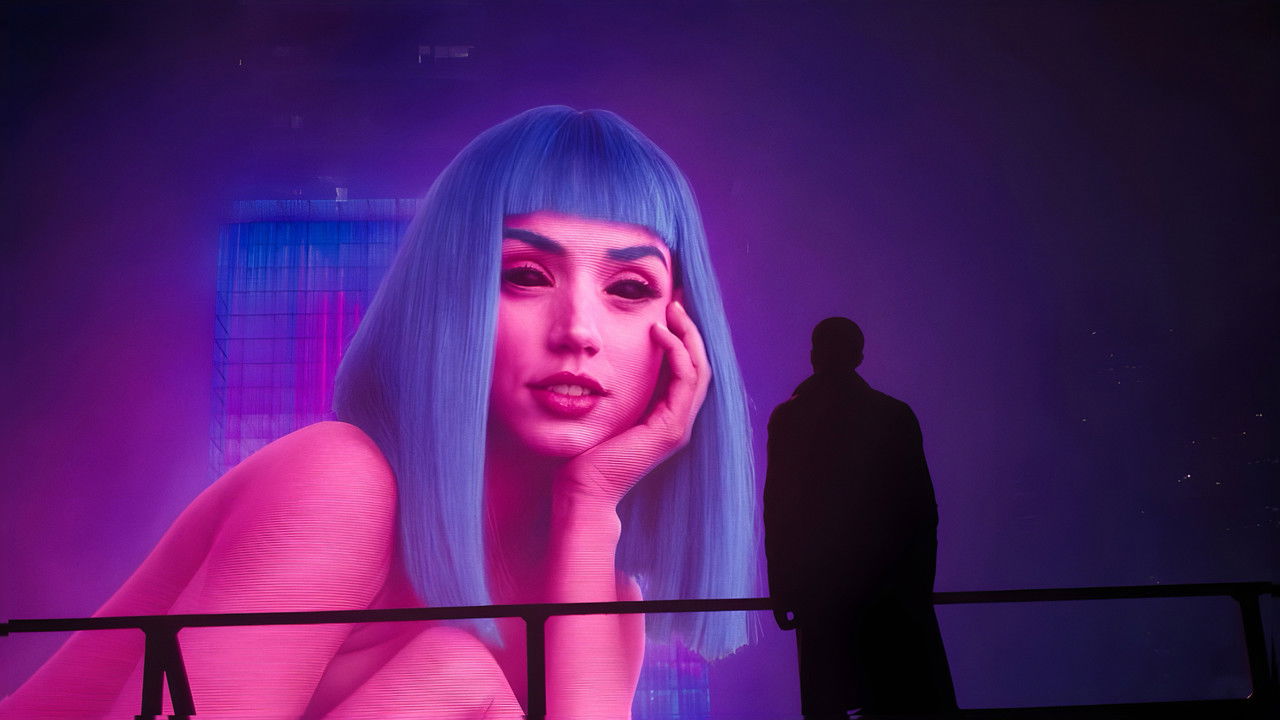
K's tiny apartment lit entirely by a soft cyan ceiling rig + the practical sodium-vapor LA-night exterior bleed through the rain-streaked window. Deakins motivated everything as practical fixtures within the apartment's ceiling cove; Joi's holographic key is the apartment's interface monitor itself acting as a screen-key on her face.
Setup defined; no fixtures plotted yet.
The rain-on-window effect was a fly-rigged dump-tank above the window plus a high-pressure mister; Lance Acord's drone-cam aerial reverse plate was added in compositing by DNEG.
Dr. Stelline's glass-bubble memory studio: a soft-grey volumetric field illuminated by a frosted-dome fixture above the chamber. The hovering memory-ball animation provides her face-key; her snow ceremony at the climax of the scene is a practical particle dump from above the dome.
Setup defined; no fixtures plotted yet.
Origo Studios Stage 6. Stelline's glass dome was a half-shell on motorised tracks; Carla Juri performed her cycle of reaches into the holographic memory ball without any digital augmentation on her hands — DNEG added the snow + memory-bubble animation in post.
Practical orange-dust haze pumped through the abandoned Las Vegas casino set; Deakins relied on a single soft top-source through the haze for the entire sequence, with no movie lighting in the set itself. The haze acts as a translucent ceiling that sells the dust-storm aftermath without a single CG matte painting.
Setup defined; no fixtures plotted yet.
Korda Studios casino build. Haze rig was a 4-machine atomiser cluster pumping orange-dye-loaded fluid; respiratory protection was mandatory for cast and crew during takes.
The first confrontation at the breached sea wall: cyan top-light from a 20K SkyPanel array across the cyclorama, with a single 2K frontal rim on K + Luv's coats picking up the wet-leather texture. The blue-grey volumetric haze is practical — a cold-vapor atomiser run continuously through takes.
Setup defined; no fixtures plotted yet.
Origo Studios Stage 5 sea-wall build. The water dump came online for the climactic fight only; the confrontation scene played dry, with the practical wave-machine kept in standby for safety reasons.
Deakins's most-discussed plot of the film: an unmotivated rippling-gold key suggesting a vast above-frame water surface. The actual rig was a 20×20ft water tank suspended above the camera with a 5K HMI hard-keyed up through the water. The rippling reflection on Wallace's face is purely practical — no DI augmentation.
Setup defined; no fixtures plotted yet.
Set was built at Origo Studios Stage 6. The Wallace amber-gold show-LUT pulls the rippling-gold reflection further into the desaturated-amber range; Paulson preserved the water-ripple cadence in the secondary grade.
Color
Pipeline
Camera color science → IDT → working space → ODT → deliverable. Production-wide default first; scenes that diverge below.
Mitch Paulson on Autodesk Lustre, working alongside Roger Deakins through the entire DI. Paulson has graded every Deakins film since True Grit. The look-build process started in pre-production with reference frames Deakins shot in Hungary; the show-LUT was a per-sequence palette specifying Wallace amber-gold, sea-wall cyan, Las Vegas orange-dust, and K-apartment cyan-with-sodium-bleed. Dolby Cinema 2D + 3D + all home-entertainment deliverables passed through Paulson's grade.
Stunts
Curated set-pieces · 3
Sequence-level rigging detail — pole-cats, decelerators, picture-car modifications, named coordinators, and the SAG-AFTRA / BSR safety bulletins observed on set. Click through for the full breakdown.
The stunt department on this production: credited crew, actor-double pairings, and the companies whose members brought them onto the show. Click any name to jump to their full filmography + doubling history.
EFILMdi ↗— Mitch Paulson colorist on Autodesk Lustre. Worked alongside Deakins through the entire DI; Dolby Cinema 2D + 3D + all home-entertainment deliverables passed through Paulson's grade.
EFILMcolor grading ↗— Paulson has graded every Deakins film since True Grit (2010). The 2049 show-LUT was a per-sequence palette specifying Wallace amber-gold, sea-wall cyan, Las Vegas orange-dust, K-apartment cyan-with-sodium-bleed.
Skywalker Soundsound mix ↗— Mark A. Mangini + Theo Green sound designers; final mix at Skywalker. Hans Zimmer + Benjamin Wallfisch score recording.
IMAX DMRimax remaster ↗— IMAX 1.90 expansion DMR remaster for the IMAX-certified theatrical release.
Score replaced late in post — Jóhannsson's original recordings were scrapped after a creative pivot. Zimmer + Wallfisch produced the released score in roughly eight weeks.


![How the world of Blade Runner 2049 was created | Production Design [No Spoilers]](https://i.vimeocdn.com/video/659892823-5d5df55802cafe4ba5cbfca8f5b1257d79fba5ece25a4e5b0c270dbc273a2400-d_640x360?&r=pad®ion=us)