Children of Men (2006) — Cameras, Lenses & Crew | CineCanon
feature · 20061h 49mGB
Children of Men
In 2027, in a chaotic world in which humans can no longer procreate, a former activist agrees to help transport a miraculously pregnant woman to a sanctuary at sea, where her child's birth may help scientists save the future of humankind.
Primary location for the Bexhill refugee-camp battle finale. The seaside town stood in for a militarised internment camp; production shot the camp exteriors over multiple weeks of base-construction + dressing.
Per-scene lighting plots: fixture role (key / fill / back / practical), color temperature, diffusion stack, and motivation notes from cited supervisor interviews.
Battersea fortress — practical museum lighting + Pink Pig matte
Practical museum-style overhead pin-spots on each art piece (Guernica, David); Lubezki shot the interior with no supplemental movie key, letting the artwork-spotlight system carry both the dramatic illumination and the visual grammar of the museum-fortress conceit.
Setup defined; no fixtures plotted yet.
Battersea Power Station exteriors filmed practical; the floating Pink Pig inflatable above the station was a deliberate Pink Floyd Animals album-cover homage. The pig was a CG composite by DNEG over a real plate of the Battersea exterior.
Car ambush — practical natural daylight + custom Doggicam rig
Lubezki shot the entire 4-minute take with practical natural daylight — no movie fixtures. The custom Doggicam interior rig allowed 360° rotation of the camera operator inside the moving car without breaking the take. Six sections were shot at four different locations over one week; DNEG's seamless digital transitions hid the section boundaries.
Setup defined; no fixtures plotted yet.
The car interior was constructed with a removable roof panel + side pop-out so the camera operator could rotate around all four passenger positions during the unbroken take. The Doggicam rig is a Lubezki + camera-engineering team innovation; later cited as the inspiration for the Mexican-cinema "tracking shot" school.
Birth scene — practical hideout fluorescents + Tim Webber CG baby
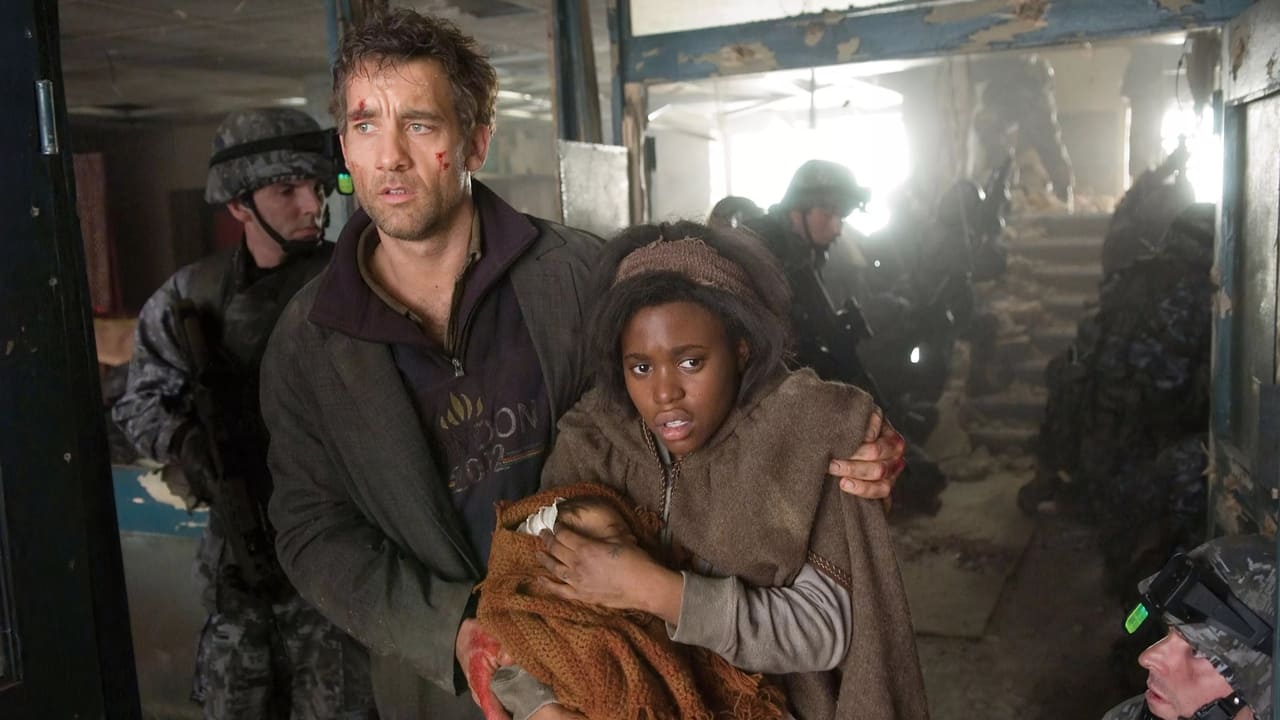
Kee's birth was shot with practical fluorescent fixtures inside the refugee-camp hideout set. No supplemental movie lighting; Lubezki rated the 35mm stock to push +1 to hold the dim practicals. Tim Webber at Framestore composited the CG newborn baby frame-by-frame across the 3.5-minute take.
Setup defined; no fixtures plotted yet.
Webber later supervised the Gravity light-box innovation — same VFX supervisor. The CG-baby work on Children of Men was a proof-of-concept for the per-frame photoreal compositing that became Webber's signature technique.
Practical natural daylight + practical streetlight + practical pyro for the entire 7-minute handheld take. No movie lighting at any point. The famous accidental blood-splatter on the camera lens (from a practical squib that misfired during a take) was kept in the final cut — Lubezki + Cuarón decided the unrepeatable accident worked in favour of the documentary aesthetic.
Setup defined; no fixtures plotted yet.
Bexhill-on-Sea + Hampshire warehouse builds combined for the camp set. The handheld single-take was shot in two sections joined via a single hidden cut; the back-to-camera turn of the operator masks the join.
Color
Pipeline
Camera color science → IDT → working space → ODT → deliverable. Production-wide default first; scenes that diverge below.
Kodak 35mm 4-perf + DI — Steven J. Scott digital colorist· production default
Camera log
Photochemical Kodak Vision2 negative
↓→
Camera gamut
Photochemical (no digital sensor primary)
↓→
IDT
Cineon-based scan IDT (35mm DI)
↓→
Working space
Cineon log working space
↓→
ODT
Rec.709 ODT for digital deliverables; 35mm contact-print pass for theatrical
↓→
Deliverable
35mm contact print + Blu-ray HD + DCP
Lubezki + Cuarón specified a desaturated, grey-overcast palette emphasising the bleak post-apocalyptic London. Steven J. Scott handled the digital intermediate (same colorist who later did The Revenant); Jim Passon was color timer for the photochemical contact-print pass; Ntana Bantu Key was digital colorist assist. The grade preserved the practical handheld documentary aesthetic — no per-shot secondary keys, no skin-tone correction, no atmospheric haze adjustment.
Stunts
2 crew
The stunt department on this production: credited crew, actor-double pairings, and the companies whose members brought them onto the show. Click any name to jump to their full filmography + doubling history.
Technicolordi ↗— Steven J. Scott digital colorist; Jim Passon color timer for the photochemical contact-print; Ntana Bantu Key digital colorist assist.
Technicolorfinishing ↗— 35mm contact-print finishing for theatrical. Photochemical answer-print continuity matched against the digital DI for the Rec.709 deliverables.